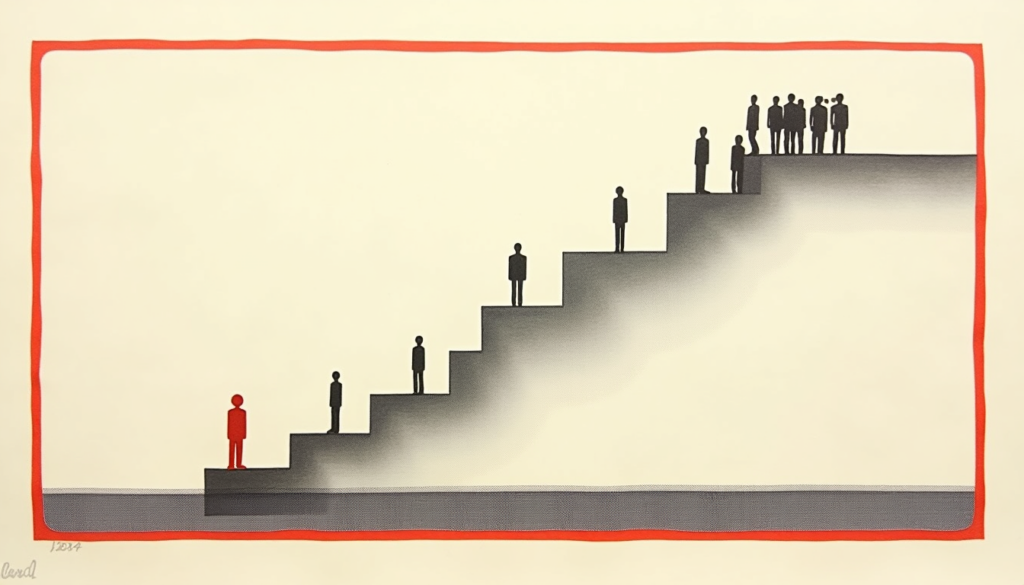
A small-business sales funnel has four stages: people find you, people contact you, you respond, the customer signs. Four stages, four numbers to track, and one simple rule for deciding where to act — always fix the stage with the steepest drop, never the stage that is easiest to improve. That is the whole thing. Twelve-box diagrams have never made anyone sign.
This piece shows how to draw that funnel in an hour, using data you already have, and how to read the result. It works the same for a renovation contractor and an industrial manufacturer: the volumes change, the structure does not.
The four stages, and the number that belongs to each
Stage 1 — Discovery. How many people see you each month: site visitors, Google impressions, views on your Business Profile, social reach. The number to keep is unique site visitors, because it is the only one that compares cleanly month to month.
Stage 2 — Contact. How many raise a hand: forms submitted, calls received, direct emails. The rate from stage 1 to stage 2 is your site conversion rate. Between 1% and 3% is normal for a service business in Quebec. Below 0.5%, the problem is the site or the traffic arriving at it, not your offer.
Stage 3 — Response. How many of those contacts get a quote, and how fast. This is the most neglected and most profitable stage: time to first reply moves the close rate more than the quality of the quote itself. We set out the mechanism in answering in five minutes.
Stage 4 — Signature. How many quotes become contracts, and at what average value. Quote-to-contract is the number most owners know by heart — and it is often the only one of the four they know at all.
Fix the stage with the steepest drop, not the one that is easiest to fix.
A worked example, so the shape is visible
Take a service company with 1,200 visitors a month. At 1.5%, that yields 18 enquiries. It reaches 12 of them and produces 9 quotes. It signs 3, at $14,000 average. That is $42,000 of monthly sales from 1,200 visitors — or $35 of revenue per visitor.
That last figure is the most useful of the lot, because it turns every marketing decision into arithmetic. At $35 a visitor, another 500 visitors are worth $17,500 in sales — and you immediately know what you can afford to pay for them. Without it, every ad budget is a guess.
Now look at where the steepest drop sits in that example: between 18 enquiries and 12 reached, a third lost to nothing more than missing follow-up. Getting that to 16 produces one extra quote, so roughly $4,700 in monthly sales — with no additional ad spend and not one more visitor.
The three places it almost always leaks
The first is the landing page: a visitor who cannot tell in eight seconds what you do and who you do it for leaves. The structure that fixes this is set out in the home page that converts.
The second is response time, already mentioned. The third is follow-up: most unsigned quotes are not rejected, they are simply forgotten. Three reminders spread over three weeks routinely recover one contract in ten — and that is exactly the kind of task a simple automation does better than a busy human, as we explain in marketing automation for SMBs.
Each leak has its own symptoms and its own diagnosis; we take them one at a time in conversion funnel leaks. And if the trouble sits later, at the moment the prospect hesitates, why your leads do not convert covers the sales side.
What a funnel will not fix
It will not fix a volume problem at the top. A perfectly tuned funnel running on 80 visitors a month produces one contract a quarter, and no amount of optimisation changes that order of magnitude. When stage 1 is too thin, the answer lies elsewhere: search, advertising, outbound. That is a budget decision before it is a technical one.
It will not fix an offer problem either. If quote-to-contract sits below 15%, the funnel is usually not the culprit: price, lead time or clarity is. No tool compensates for an offer the market does not want at the price asked.
Build the top of the funnel, or buy the enquiries
Both are defensible, and the choice mostly depends on your horizon. Building the top through content and search takes six to nine months before it carries weight, and then becomes an asset you are not renting. Buying qualified enquiries gives you volume next month, and stops the day you stop paying.
Our lead generation plans cover the second case, with territory exclusivity: $1,200 a month for 8 qualified leads, $1,950 for 15, $2,950 for 25, plus a $750 setup fee that is waived on a three-month commitment. Most of the companies we work with run both at once: the buying funds the wait while the content climbs.
If you would like us to fill in your four numbers together and find the most expensive drop, book the diagnostic call. It takes twenty minutes when the data exists, and it tells you exactly where the next dollar goes.